
If you have ever stared at a terminal window at 2:00 AM wondering why an LLM lost the context of a file you shared forty prompts ago, you aren't alone. Today's AI landscape is moving fast, and Google is shaking things up once again.
Skipping past anticipated intermediate versions, Google DeepMind has officially rolled out Gemini 4 Argon globally for developers and enterprise teams. Billed as a flagship frontier model built explicitly for deep reasoning, heavy multi-step tasks, and large-scale codebases, Gemini 4 Argon is making waves across GitHub Copilot, Google Cloud, and AI Studio.
Whether you are a software developer, an enterprise architect, or a technology enthusiast keeping pace with AI innovations, here is your complete guide to Google's latest powerhouse.
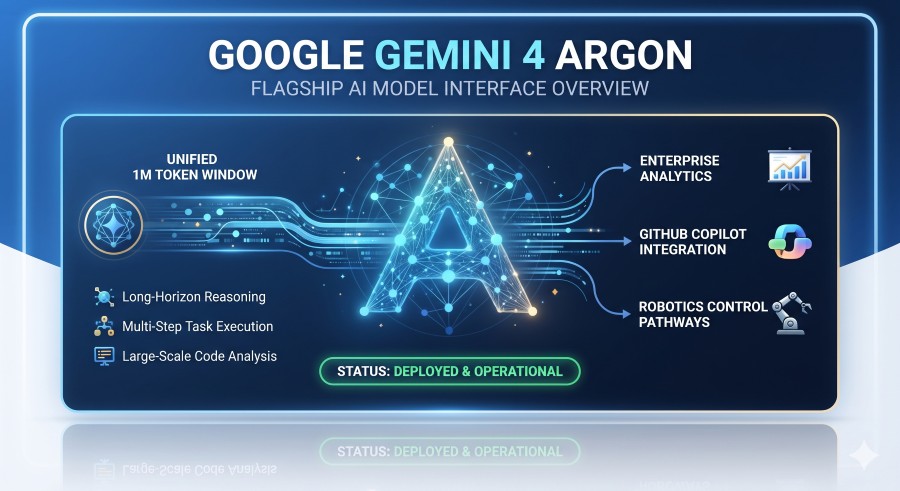
⚡ TL;DR: What Makes Gemini 4 Argon Special?
- Global Release: Available now via AI Studio, Google Cloud, and natively integrated into GitHub Copilot.
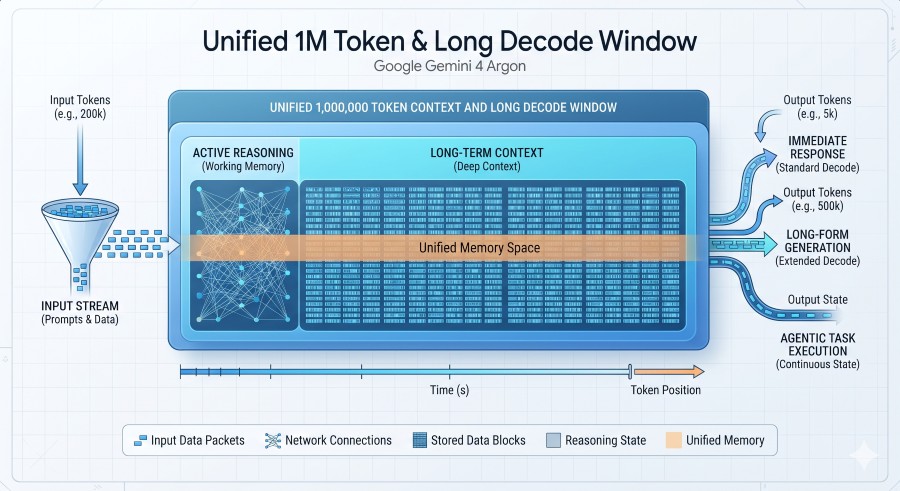
- Unified 1M Token Window: Input, reasoning (thinking), and output share a massive 1-million-token canvas with support for long decodes past 64K tokens.
- GitHub Copilot Integration: General availability means Copilot Business and Enterprise users can leverage Gemini 4 Argon directly in their IDE workflows.
- Aggressive Launch Pricing: Available at an introductory rate of $2 per million input tokens and $10 per million output tokens through November 2026.
- Top-Tier Benchmarking: Ranks exceptionally high on economic, legal, and coding metrics, leading specialized developer evaluations.
Background: What is Gemini 4 Argon?
If you felt a mild sense of whiplash looking at Google's release nomenclature, you are not alone. Rather than rolling out incremental upgrades in a predictable sequence, Google opted to leap straight into the Gemini 4 family with Argon.
A Google spokesperson confirmed that Gemini 4 Argon is substantially larger and structurally optimized differently than previous "Pro" models. Instead of focusing purely on conversational speed or brief snippet generations, Argon was trained from the ground up for long-horizon reasoning.
Think of it less as a chatbot that happens to know syntax, and more as an autonomous digital coworker capable of digesting an entire multi-gigabyte software repository, mapping its architectural dependencies, and refactoring hundreds of files in a single uninterrupted run.
Real-World Enterprise Impact
As software development grows increasingly agentic, engineering teams need AI models that don't choke when confronted with massive codebases. Google put Gemini 4 Argon to the test internally before its public release, deploying it within its own Chromium codebase—a monstrous 40-million-line project. By decoupling legacy browser features from core rendering engines across thousands of files, Argon helped Chrome engineers complete months of architectural restructuring in just a matter of weeks.
Deep Dive: Under the Hood of Gemini 4 Argon
What sets Gemini 4 Argon apart from its predecessors comes down to three structural shifts: context management, output capacity, and native ecosystem embedding.
1. The Unified 1M Token Window and Long Decodes
Previous iterations of frontier models often enforced strict walls between input text and generation limits—capping output token lengths at around 64K. When working on complex tasks like writing comprehensive unit test suites or refactoring legacy modules, models would frequently run out of breath halfway through.
Gemini 4 Argon changes this by unifying input, thinking tokens, and final outputs into a shared 1-million-token operational space. Furthermore, developers can leverage long-decode parameters to generate well past standard caps—reaching up to 1 million tokens minus your input—allowing the model to reason deeply through complex logical puzzles, mathematical proofs, or multi-file code diffs without cutting off mid-sentence.
2. General Availability in GitHub Copilot
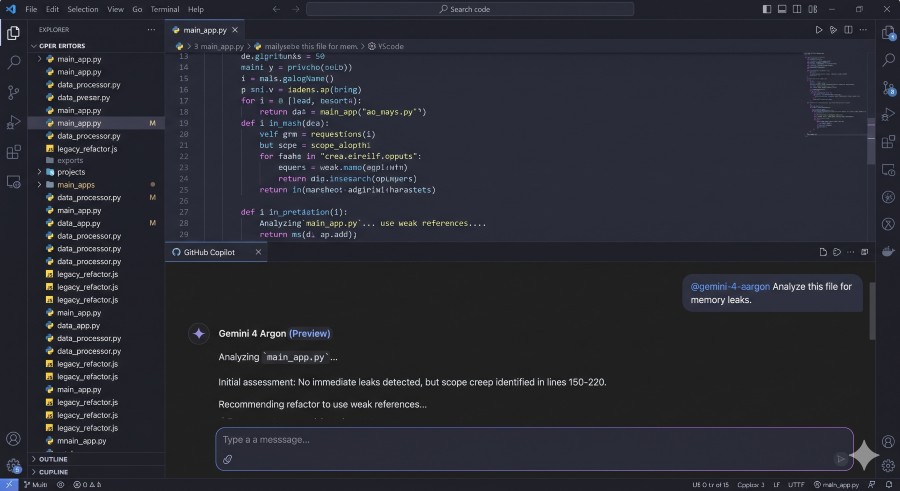
For everyday coders, the most exciting part of the rollout is integration. Gemini 4 Argon is now generally available within GitHub Copilot, rolling out gradually across Pro+, Max, Business, and Enterprise plans.
Enterprise and Business administrators can manage access directly through their Copilot model policies. Because Argon is enabled by default for organizations unless manually toggled off by an administrator, millions of developers are already testing its reasoning capabilities directly inside VS Code and JetBrains IDEs.
3. Economic Impact and Domain Benchmarks
Google designed Argon to excel across regulated, data-heavy sectors like finance, tax, legal compliance, and cybersecurity. Independent evaluations and enterprise testing partners—such as Harvey (for legal agent benchmarking) and ServiceNow—have noted substantial jumps in citation fidelity and calculation integrity compared to previous model tiers. On the Vals Index, which measures economic productivity and task success across professional sectors, Gemini 4 Argon sits near the absolute summit of current frontier models.
Hands-On: Interacting with Gemini 4 Argon via API
If you want to spin up a script to test Argon's extended reasoning capabilities using the Gemini API in Python, here is a clean, modern implementation utilizing the latest SDK patterns and background long-decode parameters.
Python Implementation Example
# Gemini 4 Argon API Integration Example
# Requires google-genai SDK (Stable v1.0+)
# Make sure your GEMINI_API_KEY environment variable is set.

import os
from google import genai
from google.genai import types

def run_argon_refactor_analysis():
    # Initialize the client using Google AI Studio credentials
    client = genai.Client(api_key=os.environ.get("GEMINI_API_KEY"))

    prompt = (
        "Analyze the following architectural snippet for memory leaks "
        "and provide an optimized, thread-safe implementation in modern Python 3.12."
    )

    # Configure interaction with background processing for long decodes
    config = types.GenerateContentConfig(
        temperature=0.2,
        max_output_tokens=65536,
        # Set background=True if handling large multi-file diff outputs exceeding standard limits
    )

    print("Sending request to Gemini 4 Argon...")
    response = client.models.generate_content(
        model='gemini-4-argon',
        contents=prompt,
        config=config
    )

    print("\n--- Argon Analysis Output ---")
    print(response.text)

if __name__ == "__main__":
    if not os.environ.get("GEMINI_API_KEY"):
        print("Error: GEMINI_API_KEY environment variable not set.")
    else:
        run_argon_refactor_analysis()
- What it does: Initializes the official Google GenAI client, configures output token parameters for deep technical reasoning, and passes a prompt to gemini-4-argon.
- Expected output: A detailed, multi-paragraph architectural breakdown complete with refactored, production-ready code blocks and security considerations.
Comparison: How Gemini 4 Argon Stacks Up
| Feature / Metric | Gemini 3.1 Pro (Legacy) | Gemini 4 Argon (New Flagship) |
| Primary Focus | General conversational & coding | Deep multi-step reasoning & agentic workflows |
| Max Output Limit | Capped strictly at 64K tokens | Up to 1M unified token window (with long decode support) |
| IDE Ecosystem | Standard plugin support | Native general availability in GitHub Copilot |
| Introductory Pricing | Standard tier pricing | $2 / million input tokens, $10 / million output tokens (through Nov 2026) |
Pros, Cons, and "Should You Care?"
Pros
- Unmatched Context Handling: The unified 1M token window means you can feed entire documentation libraries or massive scripts without losing track of details.
- Seamless Copilot Integration: No clunky workarounds needed if your organization already utilizes GitHub Copilot Enterprise.
- Cost-Effective Testing Window: Google's promotional pricing ($2/M input tokens) through November 2026 makes heavy experimentation budget-friendly.
Cons
- Compute Costs at Scale: Standard pricing kicks in starting December, meaning high-volume enterprise pipelines will need careful cost governance.
- Overkill for Simple Tasks: If you just need a quick regex pattern or a basic SQL query, lighter models like Flash variants remain faster and cheaper.
The Verdict
If you manage complex codebases, oversee automated agent workflows, or need an AI partner capable of reasoning through deeply intertwined technical logic, Gemini 4 Argon is an absolute must-test. Take advantage of the introductory pricing window over the next few weeks to benchmark it against your team's most frustrating engineering bottlenecks.
🔮 What's Next for the Gemini Ecosystem?
With Google skipping an iterative "3.5 Pro" release in favor of jumping straight to the Gemini 4 architecture, industry watchers are speculating whether smaller, specialized siblings (such as flash or ultra variants of the 4-series) will drop before the end of the year. Given Google's push into physical robotics and multimodal agent control, expect tighter integration between software generation and physical environment simulations in coming updates.
❓ Frequently Asked Questions (FAQ)
Is Gemini 4 Argon free to use?
Argon is available via paid API tiers in Google AI Studio and Google Cloud, as well as through paid GitHub Copilot plans (Pro+, Max, Business, and Enterprise). Google is running an introductory API discount through November 2026.
How do I enable Gemini 4 Argon in GitHub Copilot?
For most organization plans, Argon is enabled automatically by default. Enterprise and Business administrators can manage or restrict access via the model policy settings dashboard in GitHub.
What makes Gemini 4 Argon better for coding than previous models?
Argon supports a unified 1M token context window and long-decode generation capabilities, allowing it to analyze, refactor, and return multi-file diffs and comprehensive test suites in a single pass without timing out or forgetting earlier files.
Can Gemini 4 Argon be used for non-coding tasks?
Yes. While it excels at software engineering, Argon was built for heavy enterprise knowledge work, including legal document analysis, financial ledger reconciliation, and defensive cybersecurity threat patching.
✅ Key Takeaways
- Leap in Architecture: Google bypassed intermediate milestones to introduce Gemini 4 Argon, prioritizing long-horizon reasoning over quick text generation.
- Developer Friendly: Out-of-the-box integration into GitHub Copilot brings elite reasoning directly into standard developer toolchains.
- Try Before December: Take advantage of discounted introductory API pricing ($2/M input tokens) while it lasts.
📚 Sources & Further Reading
- Google The Keyword: Gemini 4 Argon: Built to solve your hardest problems (October 13, 2026) — Google Blog
- GitHub Changelog: Gemini 4 Argon in GitHub Copilot (October 13, 2026) — GitHub Changelog
- Google Cloud Blog: Gemini 4 Argon available on Google Cloud (October 13, 2026) — Google Cloud
- Google AI Studio: Gemini 4 Argon: Developer Guide (October 13, 2026) — AI Studio Docs
